

Continuous-wave sources for cutting
Continuous-wave fibre laser sources are the usual choice for metal cutting machines that run through long nests, mixed thickness work and daily production shifts. We help fabricators match the source to the material range, the cutting head setup and the way the machine is actually used on the floor.
What a continuous-wave cutting source does
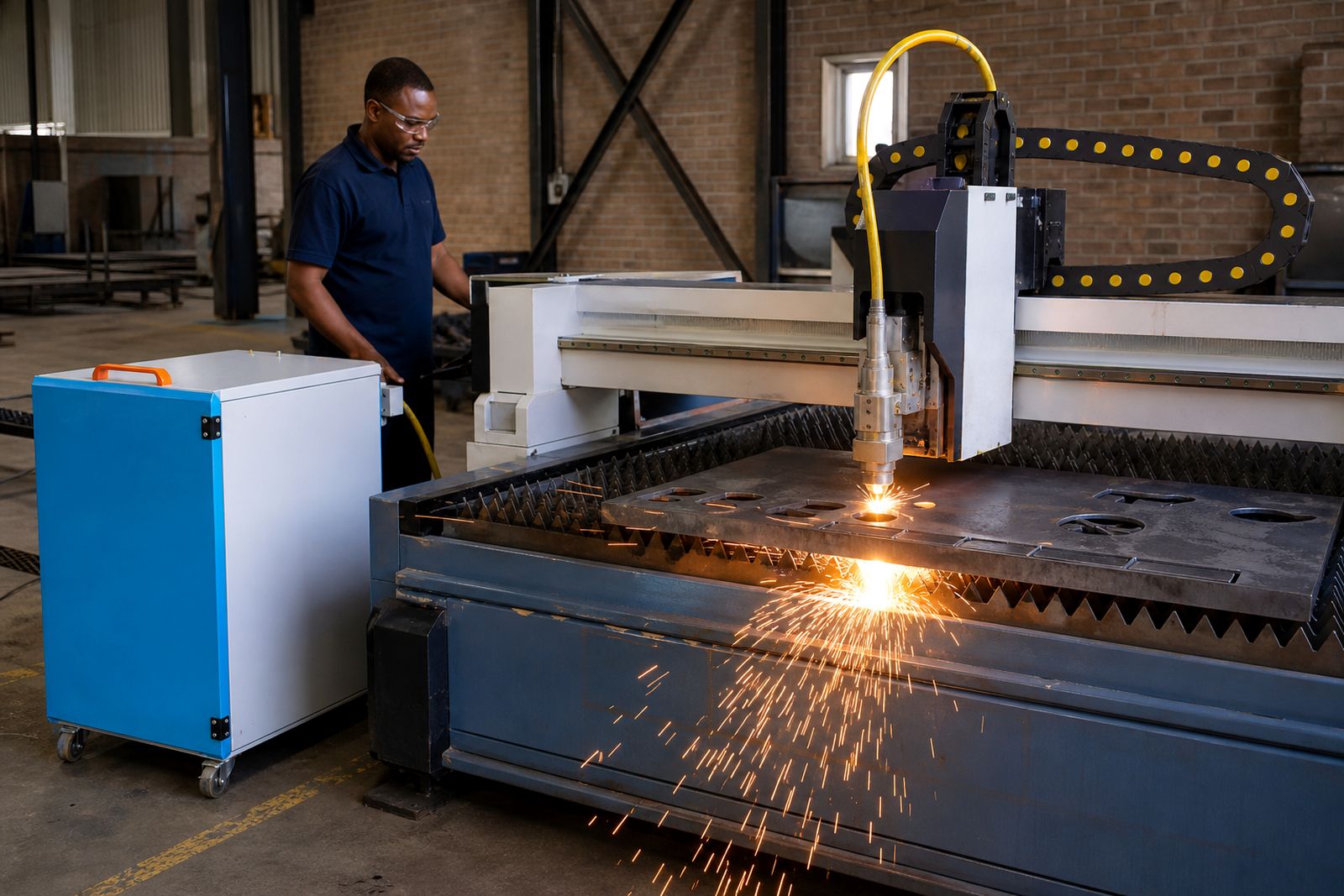
A continuous-wave source delivers a steady laser output for cutting carbon steel, stainless steel, aluminium and other common production metals on flat sheet and plate systems. In a cutting machine it works with the delivery fibre, cutting head, capacitive height control, assist gas line, chiller and control parameters, so source choice should never be looked at on its own.
For South African shops, the right source is usually the one that fits the material mix and the real shift pattern rather than the biggest number on paper. A machine that mainly cuts thin stainless all week needs a different balance to a bed that sees thicker mild steel on Monday and light bracket work on Friday.
- Steady output suited to long cutting runs.
- Used on sheet and plate cutting machines.
- Commonly paired with nitrogen and oxygen assist gas.
- Available for new installations, retrofits and replacement of failed sources.
Power bands and practical working limits
We normally discuss CW cutting sources in broad power bands, because cut quality depends on more than source output alone. Bed size, acceleration, gas purity, nozzle condition, collimation state, focus settings and sheet quality all affect the result. A medium-power source on a well-kept machine can outcut a higher-power unit on poor gas or worn optics.
Lower bands are often used for thin gauge sheet, signage parts, cabinets, brackets and stainless work where edge finish matters. Mid bands suit mixed fabrication where thin and medium plate share the same machine. Higher bands are chosen where thicker plate, faster throughput and longer duty periods matter, but they also place more demand on cooling, cleanliness and optical condition.
- Lower power band: usually best for thin sheet and lighter daily loading.
- Mid power band: a common fit for general fabrication with varied thickness.
- Higher power band: suited to heavier plate and higher production expectations.
- Not a fix for poor gas supply, unstable cooling or worn cutting heads.
Where CW sources do not suit is fine marking work, short pulse engraving, and some heat-sensitive tasks that need very different beam timing. If your machine is used mainly for marking or coded surface work, a pulsed source is often the better route.
Where these sources suit the floor
Most demand comes from sheet metal fabricators, enclosure shops, ducting lines, general engineering plants and welding departments that have added laser cutting to bring work in house. CW sources also suit replacement projects where the original source has become unstable, shows recurring alarms or no longer gives a consistant cut across the full bed.
They are less suitable where the machine frame, guides, rack, head or controls are already in poor shape. Replacing only the source will not correct backlash, vibration, gas leaks or bad height sensing. On older machines we usually want to know the head type, connector arrangement, cooling layout and alarm history before we advise on a source change.
- Good fit for production cutting of sheet and plate.
- Useful for retrofit work where integration is still sound.
- Less suitable where the rest of the machine has major mechanical faults.
- Not intended for contract cutting jobs, as we supply sources and service rather than cut customer material.
Installation needs in a real factory
A CW cutting source needs a clean electrical supply, stable cooling and sensible environmental control around the machine. In Alrode and across Gauteng, dust from fabrication, grinding and forklift traffic can shorten optical life if the source bay and head area are left open or dirty. Coastal humidity can also show up in connectors and optics if consumables are stored badly.
Before installation or replacement, we check the available mains supply, earthing, chiller condition, hose routing, interlocks and fibre path. Enough floor space is needed around the cabinet for access and airflow. If the machine lives in a hot bay with afternoon heat build-up, the cooling side needs attention first or the source may trip under load.
- Stable mains power and correct earthing.
- Cooling capacity matched to the source and duty cycle.
- Dry, clean optical connections and protected fibre routing.
- Access space for service, filter cleaning and alarm checks.
Care, alarms and parts that matter
Good service life depends on housekeeping as much as cutting settings. Protective windows, nozzles, ceramics and head seals need routine checking, because contamination at the head can send heat and back reflection up the optical chain. The source itself should be kept within its cooling range and alarm logs should not be ignored after the machine resets and carries on.
Common problems include unstable power output, over-temperature alarms, communication faults, connector contamination and chiller-related shutdowns. A lot of time is lost when shops replace parts one by one without checking the full system. We trace whether the fault starts at the source, cooling, control side or cutting head so the repair path is a bit clearer.
For daily care, keep the machine area clean, log recurring alarms, change consumables before they fail badly and avoid opening optical connections unless the area and tools are clean enough for that work.
What to send when you enquire
The quickest way for us to assess a CW source requirement is to understand the job range and the machine already on your floor. If you are replacing a failed source, include the fault behaviour and any alarm wording shown on the machine or source panel. If the plan is a new build by your machine integrator, tell us the intended material range and production pattern.
- Material types and usual thickness range.
- Sheet size or plate size used on the machine.
- Whether the work is mainly thin sheet, mixed fabrication or heavier plate.
- Current source details, if fitted, and whether the issue is failure, instability or planned upgrade.
- Photos of the source label, connector side, chiller and alarm screens where possible.
- Your town, whether site service is needed, and any access limits for the workshop or factory.
You can send those details through our contact form and we will line them up against source options, likely integration points and the spares that may also be needed for a proper changeover.
What our Fibre Laser customers say
Verified Google reviews
Questions we get asked
Can a higher-power source fix poor cut quality on its own?
Not usually. Gas purity, nozzle condition, focus settings, head alignment, sheet condition and cooling all affect the cut. We look at the full machine before advising on a source change.
Do you replace failed cutting sources on older machines?
Yes, where the machine structure and controls still make sense to keep in service. We check connector type, cooling, alarms and head compatibility before recommending a replacement path.
Can these sources be used for marking work?
Continuous-wave units are mainly for cutting and some related process work. For dedicated marking, coding or fine pulse control, a pulsed source is normally the better match.
Also worth a look
Tell us about the job
Send sizes, materials and where you are through our contact form, and we will come back with the practical options.
Open the contact form