

Pulsed sources for marking
Pulsed fibre sources are used where the job needs a controlled mark on metal and selected plastics without the heat spread of a cutting source. We help workshops match the source to the marking head, the material and the shift pattern before parts are fitted.
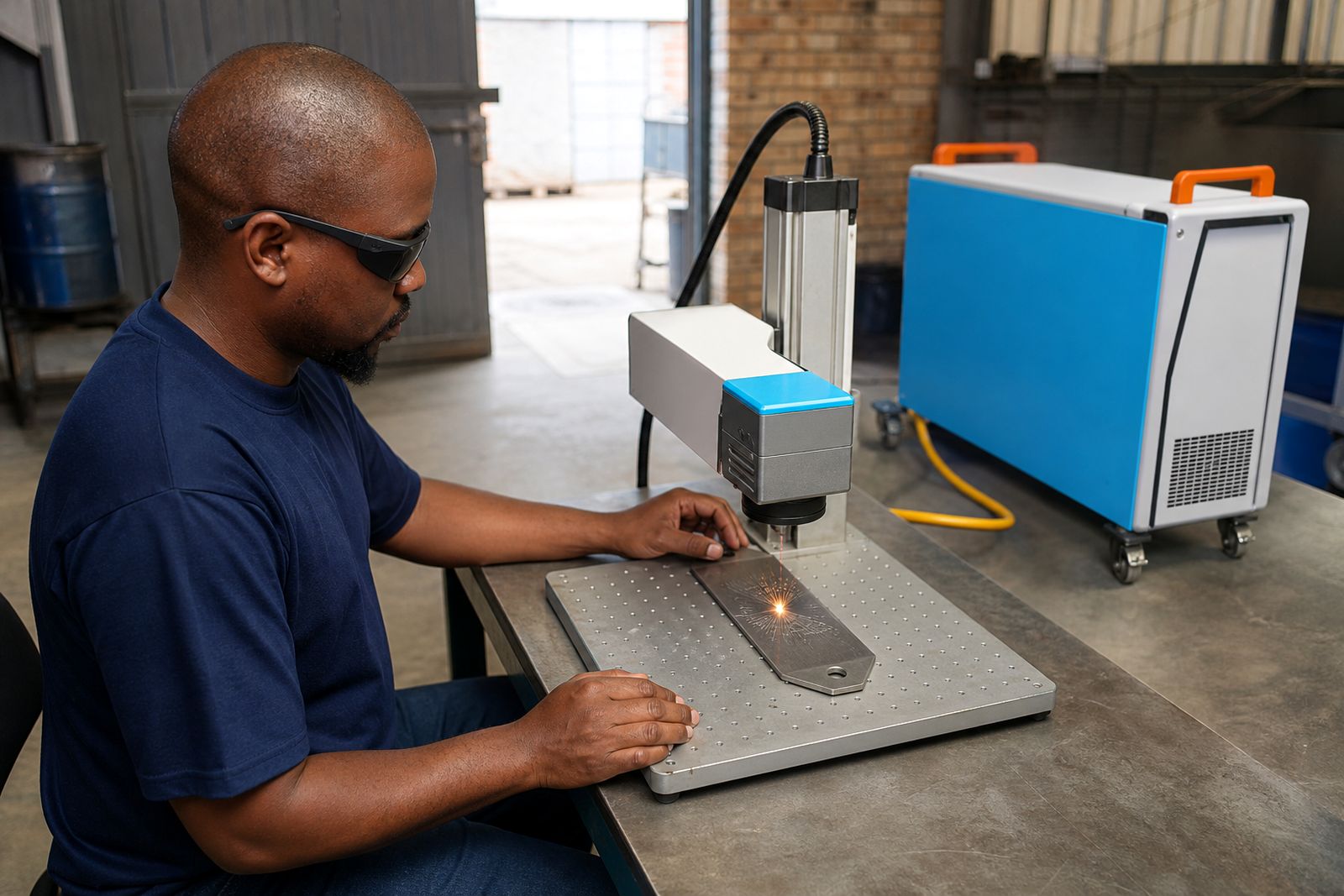
Built for marking, engraving and traceability
A pulsed source sends short bursts of energy to a marking system rather than a continuous beam for cutting. That makes it suitable for batch codes, serial numbers, logos, data matrix marks, shallow engraving and surface treatment on stainless steel, mild steel, aluminium, brass and other common factory metals.
These units are compact compared with cutting sources and are usually chosen for bench marking stations, enclosed work cells and small integration jobs on production lines. The right setup depends on the lens, the scan field, the material finish and the mark depth expected. A polished stainless tag behaves very differently to black mild steel plate, and anodised aluminium can need a different approach too.
- Good fit for part identification, asset tags and QR or data matrix marking.
- Suitable for shallow engraving where the cycle time target is realistic.
- Useful on metal parts that must stay dimensionally stable after marking.
- Often paired with compact scan heads and local fume extraction.
Source sizes and the limits that matter on the floor
Pulsed marking sources are offered in small and mid-range outputs for different duty levels. Lower output units suit serial plates, tools, panels and light daily use. Mid-range options suit faster cycles, darker annealed marks on some stainless grades, and shallow engraving on production batches. The important point is not only source output but how that output is delivered through pulse width, repetition rate and beam quality.
Working limits show up when the mark area becomes large, the material is highly reflective, or the brief asks for deep engraving at speed. A small pulsed source will not replace a cutting source, and it is not the right answer for sheet profiling, seam welding or thick material removal. On coated parts there can also be edge charring or colour shift if settings are pushed too hard, so it helps to tell us what finish the part has before a source is selected.
- Smaller units suit intermittent work, fine text and compact mark fields.
- Mid-range units suit higher throughput and more demanding surface contrast.
- Deep cavity engraving is possible only within sensible cycle times and material limits.
- Large format fields can reduce energy density and affect line sharpness.
Where a pulsed source fits well and where it does not
These sources suit workshops that need repeatable identification on finished parts, machine builders adding traceability to assemblies, and service departments marking replacement components before dispatch. They are also useful where the mark must stay legible after paint, oil or moderate abrasion, provided the test piece is checked first.
They do not suit full-sheet cutting machines, hand welding jobs, or applications where the goal is rapid bulk cleaning over wide areas. For those duties a continuous-wave or dedicated cleaning setup is normally the better route. If the line needs colour marks on plastics, some materials will respond cleanly and others may melt, bubble or discolour. A small sample helps avoid a wrong call here, especialy on mixed polymers.
- Best on metals and selected technical plastics.
- Less suitable on soft consumer plastics that distort easily.
- Not intended for plate cutting or structural welding.
- Not a substitute for a high-throughput engraving spindle where heavy stock removal is required.
Fitting requirements in the machine or work area
Most pulsed sources are straightforward to mount in a marking cabinet or a compact machine frame, but the whole system still needs proper planning. The source must match the control setup, the fibre routing must be protected from tight bends, and the beam delivery side must stay clean. In Gauteng workshops dust from grinding and fabrication often finds its way into every cabinet, so enclosure condition matters more than many teams expect.
Power quality should be stable and the work area should stay dry and reasonably clean. Heat load is lower than on a cutting source, but cabinet ventilation still matters, and some systems use light external cooling depending on the source class and enclosure layout. Marking stations also need sensible extraction because smoke and fine residue can coat optics and reduce mark quality over time.
- Stable mains supply and correct earthing are important.
- Clean cabinet space with protected fibre routing.
- Extraction for fumes, smoke and fine residue at the mark point.
- Dry storage and handling for optics, connectors and spare windows where fitted.
Care, fault finding and service support
Most marking problems blamed on the source start elsewhere: dirty optics, weak extraction, loose electrical connections, software parameter changes or a damaged delivery fibre. Before a unit is removed, it helps to check the symptom against the material, the lens condition and the mark file. Faded marks, uneven fill and random alarms each point to different causes.
Routine care is mostly about keeping the system clean and handling the optical path carefully. Do not force connectors, do not leave exposed ends open in a dusty area, and do not ignore rising cabinet temperature. If a unit shows an alarm, tell us the alarm wording, the machine type and what changed before the fault started. We service source and machine issues in our workshop and on site around Alrode and Alberton, and we support customers elsewhere in South Africa where the fault brief is clear enough to plan the job properly.
What to send with your enquiry
A good enquiry saves time on both sides and helps us suggest the right pulsed source or repair route. If the unit is for a new marking station, tell us the materials, part size, mark content and expected daily volume. If it is a replacement or repair, include the current source details and the fault symptoms. Photos of the source label, connectors and the finished mark are very useful.
- Material type, thickness and surface finish.
- Mark content such as text, logo, serial number or code.
- Approximate mark size and lens field if known.
- Whether the work is light identification, dark marking or shallow engraving.
- Machine type, controller details and any alarm shown.
- Photos of the source, fibre connection and sample marks through our contact form.
If the work area is coastal, mention that as well, because humidity and salt-laden air can affect cabinet condition and connector care over time.
What our Fibre Laser customers say
Verified Google reviews
Questions we get asked
Can a pulsed marking source cut sheet metal?
No. A pulsed marking source is for marking and light engraving, not for profiling sheet or plate. If the job is cutting, a continuous-wave cutting source and the correct machine setup are needed.
Will it mark every plastic cleanly?
Not every plastic reacts well. Some grades mark neatly, while others can melt, bubble or change colour in an uneven way. A sample part or a clear material description helps before a source is chosen.
What usually causes weak or patchy marks?
Common causes include dirty optics, poor extraction, changed parameters, fibre damage, unstable power or a mismatch between source size and the job. The source itself is only one part of the system.
Also worth a look
Tell us about the job
Send sizes, materials and where you are through our contact form, and we will come back with the practical options.
Open the contact form