

Welding and cleaning modules
Our welding and cleaning modules are compact fibre laser sources used in handheld laser welding and surface cleaning systems. We help South African fabrication teams match the module to the job, the shift pattern and the machine around it.
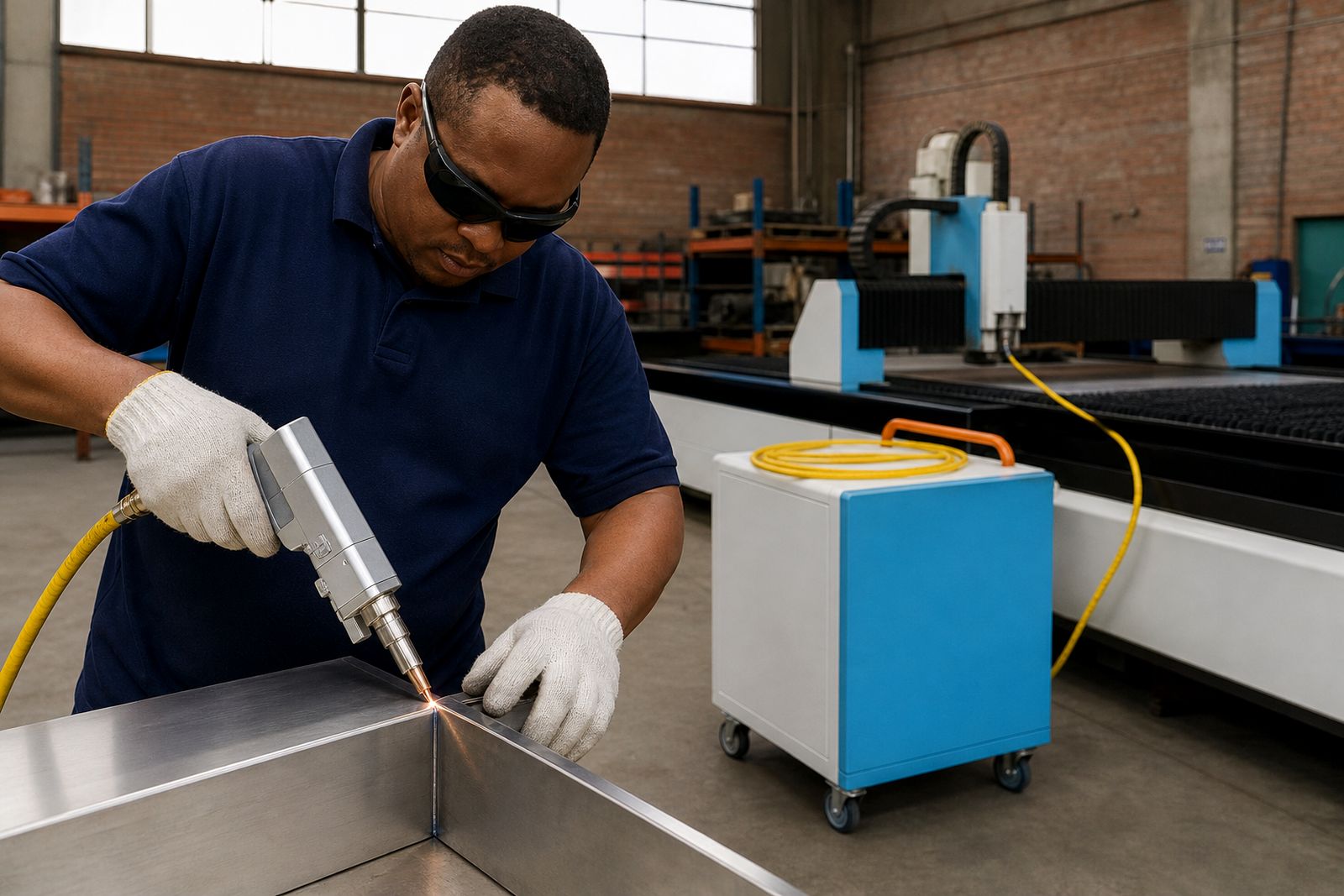
Built for handheld laser work
These modules are used where a machine needs a compact source for handheld welding or laser cleaning rather than a full cutting setup. In most shops they sit inside a cabinet with a chiller, control hardware, gas connections and the welding or cleaning head, then feed the process through a delivery fibre. The aim is stable output for repeatable welds, cleaning passes and start-stop production without forcing a large cutting source into a smaller job.
For Gauteng workshops, mobile repair teams and coastal factories, the right module choice matters because duty pattern, ambient heat and dust levels change how a system behaves over a full week. We supply source options and related parts for new builds, replacement work and faulted systems already in service.
- Used in handheld welding systems for mild steel, stainless and similar production work.
- Used in laser cleaning systems for rust, paint, scale and surface preparation, where the machine specification allows it.
- Suitable for retrofits when cabinet space, cooling capacity and control compatibility are checked first.
Module sizes, options and practical limits
Welding and cleaning modules are usually chosen by output class, control method and the cable and connector arrangement needed by the machine. Lower-output units suit lighter gauge welding, shorter daily runs and more compact cabinets. Mid-range units are often the practical choice for general fabrication. Higher-output options can give faster travel speeds or broader cleaning coverage, but they also place more demand on the chiller, the optics and the mains supply.
Working limits are not only about source output. A handheld welding head, the wire feed arrangement, shielding gas quality, lens condition and operator settings all affect the result. Cleaning work has its own limits too. Thick coatings, uneven scale or heat-sensitive surfaces may need slower passes, narrower scan settings or a different process entirely. A module that looks suitable on paper can still be the wrong fit if the cabinet airflow is poor or the delivery fibre route is too tight.
- Lower output classes suit lighter material and shorter duty cycles.
- Mid-range classes suit general shop welding where joint fit-up is controlled.
- Higher classes need stronger cooling, careful optical care and sound electrical supply.
- Cleaning setups depend heavily on scan head settings, stand-off and surface condition.
Where these modules fit well, and where they do not
These sources fit well in fabrication shops making brackets, enclosures, frames, tanks, covers and light structural assemblies where handheld welding gives cleaner joints with less post-grind work. They also suit maintenance environments where a cleaning system is used to strip oxidation or prepare a local area before further processing. In smaller workshops the compact format helps when floor space is tight, but the rest of the machine still needs proper layout and cooling.
They do not suit every task. If your work is mainly high-volume flat sheet cutting, a dedicated cutting source and machine layout are the correct route. If the material is heavily reflective, contaminated, badly gapped or very thick for a handheld process, expectations must be set properly. We do not build complete cutting machines or take on contract cutting, but we do help assess whether the source inside your welding or cleaning system is matched to the actual work.
Site and installation requirements
Before a module is fitted, we look at the machine cabinet, chiller size, head type, control interface and site conditions. Stable mains power matters because welding and cleaning systems draw through the full electrical package, not only the source. In areas where power quality is rough, nuisance alarms and stoppages are more common. Workshop heat, fine dust and poor airflow also shorten consumable life and can push internal temperatures too high.
At coastal sites, humidity and salty air can be hard on connectors, optics storage and cooling components if the machine stands open for long periods. Delivery fibre routing needs care as well. Tight bends, crush points and rough handling during moves are a common cause of trouble, even when the source itself is still sound.
- Enough cabinet ventilation and clean air paths around the source.
- Correct chiller capacity and coolant condition for the installed module.
- Electrical supply suited to the machine load and local protection requirements.
- Safe fibre routing, secure connector seating and clean optical handling.
Care, fault finding and service support
Most avoidable faults start outside the source. Dirty protective windows, worn nozzles, poor gas flow, contaminated water loops and damaged delivery fibres all show up as unstable process results or source alarms. A machine can look like it has a source fault when the real issue sits in the head, the chiller or the interlock chain. We help customers read the symptoms properly before parts are swapped out for no reason.
For workshop and site service, we inspect the source condition, alarm history, connector faces, cooling performance and basic machine health around the laser package. If a repair is needed, we handle source diagnostics and machine service in our workshop and on site where practical. That saves a lot of guessing, and in many cases the fault sits with a consumable or connection rather than the module core.
What to send when you enquire
The easiest way to get the right recommendation is to send the machine details and the job details together through our contact form. If the machine is down, include the alarm wording exactly as shown, even if it looks minor. Photos of the source label, head, chiller panel, connector ends and the weld or cleaning result help more than a long description alone.
- Whether the machine is for handheld welding, cleaning, or a combined setup.
- Material type, typical thickness and joint type or cleaning target.
- Current source model, connector style and delivery fibre length if known.
- Chiller make-up, machine voltage and whether alarms appear during start-up or under load.
- Your town and whether the unit is in Alrode, elsewhere in Gauteng or another province.
If you are replacing a failed module, tell us what happened before the stop, not only that the machine will not run. A sudden shutdown after overheating, coolant loss or a damaged fibre route points us in a different direction than a gradual loss of weld quality. That bit of context saves time and avoids ordering the wrong part.
What our Fibre Laser customers say
Verified Google reviews
Questions we get asked
Can one module do both welding and cleaning?
Some systems are configured for both functions, but compatibility depends on the control package, head arrangement and the way the machine was built. The source is only one part of that decision.
Will a higher output module always weld faster?
Not always. Travel speed also depends on material, joint fit-up, gas coverage, head setup and lens condition. If the rest of the machine is not matched properly, extra output may bring more heat and instability rather than better production.
Do you repair complete cutting machines?
We service and repair laser sources and support cutting and welding machine maintenance, but we do not build complete cutting machines or provide contract cutting work.
Tell us about the job
Send sizes, materials and where you are through our contact form, and we will come back with the practical options.
Open the contact form